When we go into the woods, we bring a lot of stuff with us, and often times leave some of it behind, quite often by accident. Then there is the excrement that we intentionally leave behind. Lets start off focusing on what we are intentionally are leaving behind.
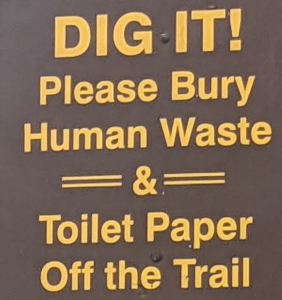
When you have to go to the bathroom in the woods, ideally you will want to use some kind of dedicated facilities like latrines and privies. In the Adirondacks there are also "thunderboxes" which are just a box with a seat over a pit, so a bathroom with a view. If you cannot use a dedicated facility, you want to make sure you are not doing it where others are going to find it, and it won't contaminate any water sources. This means you should walk 200 feet away from any trail or water before you do your business. Some parks will have different distances, but 200 is a good rule of thumb that usually exceeds the local regulations. Even if you are just going to pee, you want to do it far away from the trail and water. It is very frustrating to be hiking in the winter and finding all these little yellow spots along the side of the trail because people didn't bother to go even a few feet off the trail.
When you are pooping, or if you're dealing with menstrual flows, you want to bury your waste. At minimum, you want to bury it 6 inches down. This will be deep enough that the animals won't disturb it, and not so deep that it won't be able to decompose. The question now comes up about the paper. In general, you can bury it with the waste, but there is no harm in packing it out with you. If you're packing it out just make sure it's bagged up well, and its obvious that this bag shouldn't be used for anything else. If you are dealing with menstrual flows, you need to pack out your products. Almost all pads and tampons all have plastics in them and they will not decompose in any reasonable time frame.
Now there are exceptions to this practice. When you are above treeline or areas where the soil is not 6 inches deep, you will need to pack everything out. There are also individual parks that have specific rules that require you to pack the paper and sometimes everything out. Before you go, check the local regulations to know what you have to do. In the event you are in a sensitive environment or are required by regulations, there are things like Wag Bags that are designed to defecate into, bag it up, and carry it out. A really good book on this topic is How To Shit in the Woods by Kathleen Meyer.
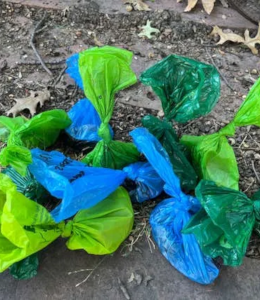
Pet waste is also something that you need to take care of while hiking. Most people don't want to take the time to take their animal 200 feet off trail, dig a hole, and have their animal go in the hole. Lets be honest, none except the most well trained dogs will do that. So, their waste should be bagged and taken out. That last part is the key part. Dog waste bags are plastic, and they will take a long time to decompose. I have seen a statistic saying 1000 years for the bag to decompose. Now there are compostable bags, but they only decompose in commercial composters, not even in the vast majority of your home composters. This is one of my pet peeves on the trail, no pun intended. So many people will leave the waste bag on the side of the trail and plan to pick it up on the way out, but a large percentage of those hikers forget to do that. There's also a number of hikers that go out of their way to try to hide the bags with the intent of leaving it there, to take up to 1000 years to decompose. If you're hiking with an animal, please, plan to pack it out when it happens, and don't leave it on the side of the trail.
Excrement is not the only waste we have to deal with on the trail. We also have to think about all the other things we bring into the woods. Here there is less of an `ick` factor than when dealing with bodily functions. Instead, this is more focused on litter and how long it takes for it to decompose. Some stuff will decompose quickly, others will never decompose, but just break down smaller and smaller but still fundamentally stay the same thing. A great exercise to try is the Trash Timeline that LNT offers. The first time I did this, there were a few things that came up that totally surprised me. Take a look and see what surprises you.

Orange peels, banana peels, apple cores, and similar, they all take a few years to decompose. But they also are things that animals may try to eat. This starts the animal associating food with humans, and they start to pester humans for food. While small animals like chipmunks and squirrels can be cute doing this, larger animals like bears are not. I'm starting to get into #6 Respect Wildlife, but it also is a concern here. Please plan to take all your food waste out with you.
Another thing to do while hiking is to pick up the trash you find along the trail. We all will at some point drop something by mistake. Things fall out of pockets, wind picks up and sends a wrapper flying. It happens. Try to make it not happen, but don't beat yourself up when it does. What you can to do make up for it is pick up other peoples' trash. The easiest way to do this is what's called a trash pocket. This may be a pocket in your pants, a pocket on your pack, or just a ziploc bag. When you see trash on the trail, just pick it up and put it in the trash pocket. You don't have to pick up the really disgusting stuff, but if you have a spare plastic bag, you can turn it inside out to pick it up. Remember when you get back to the car, or at least before you do wash, to empty the pocket out. This is by far the easiest way to make an impact that people will notice.
Unfortunately, we're finding that we're leaving a lot of small stuff that we cannot easily control I'm talking microplastics. There was a study where they were checking backcountry bodies of water for microplastics, and the highest body of water in NY had a high amount. They studied further and there appears to be a good chance that hikers are the cause. With all of us moving towards synthetic clothing, we're shedding all kinds of microplastics as we hike. A lot of hikers are moving to softer soled shoes, and these too are shedding more microplastics. Unless we go back to all untreated natural fiber clothing, we're not likely to stop shedding microplastics. Thankfully some of the bigger outdoors equipment and clothing companies are aware of this and are starting to look into how to prevent it.