Principle 1 is about your safety. This principle starts to get into what your impact to the environment is. Nature can be fragile, and our recreation in it causes damage. In some cases, the damage is minor and nature can recover quickly. In other cases a single step could take decades or longer to recover from. That is why you need to travel and camp on durable surfaces. So, what is a durable surface?
In essence a durable surface is a surface that can handle the impact of our activities without causing any long term damage. The easiest way to do this is to stay on established trails and camp in established sites. We're usually pretty good about where we camp, but you will still find people camping on moss or plants like ferns. Camping on forest duff or bare dirt is what you want to do if you cannot camp at a designated site, and you want to take many different routes into and out of camp to spread your impact out and not form social trails around your site. Where we tend to get the most impact though is hiking.
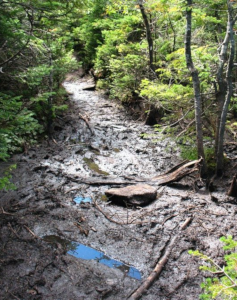
Lets talk about MUD. There is a large number of hikers that don't want to get their boots dirty or wet. As a result when they come across a patch of mud or a puddle on the trail, they go around it. In the shoulder seasons when you get patches of ice on the trail, people do the same thing. This stepping to the side of the trail does a lot of damage to the trail. The first thing that you will find happens is the trail widens. As this happens, it encourages others to go around, and the trail keeps widening. The other thing that happens is the small bit of mud on the trail grows into a larger and larger mud pit. An extreme example of this is something that has happened in the High Peaks of the Adirondacks. On the herd path between Panther and Couchsachraga, in the col there was a wet spot in the trail until the late 1900s or early 2000s. Tens of thousands more hikers later, that wet spot is a bog. There is plenty of wood in the bog to use to get across, but people keep wanting to avoid getting muddy or wet, so they keep going around, and keep expanding the bog. There are a few more places I've seen in that region that have similar starting to happen.
Obviously then, when you're hiking, the side of the trail is not a durable surface, the center of the trail is. Make your best effort to hike through the center of the trail. This will mean you will hike through mud and puddles. Get yourself a good pair of waterproof shoes that can handle being submersed in mud. Trails in general should be one person wide. Some of the high traffic trails may be designed to be two people wide, but even those should be hiked single file. I have been up trails that were single person wide when they were designed that are now ten feet wide because people keep trying to avoid walking up the center of what is now a slab due to human caused erosion. Many hikers don't want to go up the slab, but instead want to go through the woods, or hold the trees to go up it. This is partly a trail design issue that whenever the trails get rebuilt/rerouted will likely be addressed. When the slabs in question are extremely rough and provide plenty of grip even when wet, there is no reason to keep widening the trail. Education of how to walk up the slabs would significantly reduce this trail widening.
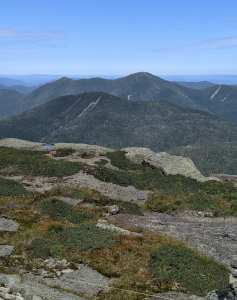
When you get up high, at and above tree line, you may start running into sensitive vegetation. Alpine vegetation cannot take much impact. Some of the plants will die as a result of a single footstep. We should do everything we can to avoid walking on high elevation plant life. The trails will have paint markers or cairns that show you the way you should go. Make all efforts to keep on the rocks. Thanks to the work of Dr. Edwin Ketchledge, a professor of environmental studies, we have a better understanding of our impact on these alpine zones. He was able to convince people to carry up dirt, fertilizer, and grass seeds to the top of Algonquin mountain (second highest peak in New York, and about a 3.5 miles and 3000 feet of elevation in from the nearest trailhead) to set up a base dirt layer and allow the alpine vegetation to grow back. Amazingly, it worked. This has become the model for other states, and is the origin of the summit steward program for ADK. It is now common on the bald peaks in the north east to find small rocks or strings outlining the trail, and signs asking you to stay on the bare rock. With the summit steward program, they have people on top of the more popular mountains every day through the summer to educate about the plant life, and the damage we have done.
So, lets talk specifics. What can you walk on, what shouldn't you, and what is in that in-between area where you can, but you need to take precautions. This is not an exhaustive list, but it will cover your most common terrain.
| What you should not walk on | What you should walk on |
|---|---|
|
|
There are a few surfaces that will depend on the situation:
- Short grass is generally durable, and can take hundreds of footsteps. It is best to spread out though and spread the single footsteps of damage out instead of concentrating the impact and forming a social trail
- Mud is a durable surface if it's on a trail or in a campsite. When it isn't in either of those locations, it isn't durable.
- Sand dunes, and their vegetation can be sensitive environments. Most local authorities will block them off to protect them.
- Snow and ice are durable surfaces when they are thick enough. Generally speaking snow depths of 6 inches or more are durable, and ice that is thick enough that it covers everything below, or in the case of lakes and streams, thick enough to walk on is durable.