Snowshoes are a very personal preference, but there are some general things to think about when you are looking for snowshoes.
Size:
The manufacturers typically push you to a larger size than is truly needed. What they typically point you to is the size of snowshoe you would need if you were to be breaking trail all the time. For me, at around 200 pounds with pack MSR said I needed their longest ones (30 inches). I found this to be bad advice. The vast majority of the snowshoeing you will encounter will be packed or groomed trails. Most people don't do any kind of significant breaking of trail. As a result, the next size smaller is typically a better fit. Unfortunately, most manufacturers its the same price for all their sizes, so you're not saving anything money wise. In the event that you do find yourself in need of breaking trails, many of the better snowshoes sell tails that will add 5 inches to the shoe. These are great when you need them, and you can save the weight when you don't.
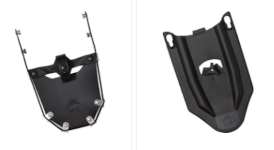
With the shorter shoes, you are knocking a few more ounces off your pack and feet. This loss of weight doesn't seem like much, but over a long hike, especially when wearing them on your feet, it becomes significant. The awkwardness of the shoes are also less making the shorter shoes easier to hike with overall. The other good thing about shorter shoes is agility. The packed trails can be tight in spots. This is especially true when you're going in and around boulders. There will be spots where a 25 inch shoe will fit, but a 30 inch will not.
Bindings:
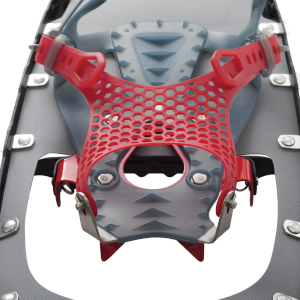
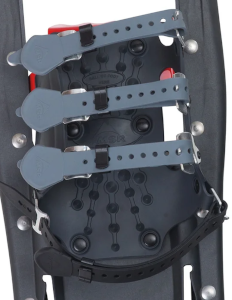
Snowshoes generally have 2 kinds of bindings. One is multiple straps that go across the toes, the other is a basket that encases your toes. All bindings will have a heel strap that holds your foot into whatever toe binding you have. These are not the only kind of bindings out there as I have tried a hybrid that was neoprene that wrapped around the toe and secured with a shoelace. I broke that binding putting it on, and haven't seen it since.
Which binding is better? That is all personal preference. For me it comes down to how secure the binding is. This means looking at how the straps lock down. The simplest is the use of a stretchy strap with a belt buckle type pin/hole setup. There are others that wind a cord up, or offer a finer friction based adjustment on the strap. Which one you choose is up to you. The most reliable ones from what I have seen are the pin/hole method. That said, they are not foolproof, and I have seen all kinds of bindings come undone under use, including on my own shoes. One trick that some bindings come with is to secure the strap past the pin/friction point so the tail doesn't flap around and all but beg for it to come loose. If your bindings don't have these extra pieces to tie the ends down, small hair ties or zip ties work well. They don't need to be tight, they just need to keep the ends from flopping around.
My personal experience is that the baskets with the peg/hole straps tend to be more secure overall. I have had to adjust or fix my bindings much less frequently than my hiking companions with other kinds of bindings. That said, I have had times where I didn't strap it tight enough, or the tails of my straps got unhooked and I had to stop and readjust. All bindings will loosen up on you at the worst possible moment. So, choose one that works for you, and keep an eye on them when you're hiking.
Construction:
There are two general constructions for modern snowshoes. One is a fabric that is stretched between a frame. The other is a solid plastic plate. I can't say one is better than the other. I have seen both types in the woods, and they both work. The fear for either is breakage. For the fabric type, this is usually a fear of one or more of the connection points failing, and if that happens, you still have some flotation, just not as good. The plastic plate version is a bit more destructive when they fail, but you can still have some flotation unless it breaks through the binding.
The binding is the typical weak point you have to worry about. Ask yourself what can break and how you can fix it. Often you're talking rivets that may fail. Sometimes it's a pin and ring setup that could be replaced. The reality is that field repair is not going to be something that is delicate. It's going to be something that is slapped together to get you out, and you'll do a more permanent repair when you get home, everything defrosts, and you have the time to do it. Realistically, you're going to be field repairing with zip ties, paracord, or something similar that very likely will have to be replaced a couple times on your way out. When it's below freezing, you work quickly to get something that will hold and hope it holds the whole way out. Before you go out, look at the likely failure points and make sure you have stuff that you can do a quick repair if necessary.
Features:
There are snowshoes for every kind of terrain. Sometimes you can use them on multiple, but really, they tend to be specialized. So ask yourself what you're going to use the shoes for. I have seen racing shoes used in the mountains, and they worked, but they were ruined by the end of the hike. Since I am focused on hiking in the mountains, what follows is focused on that. If you're looking for shoes for different environments, I suggest further research, and talk to a knowledgeable person at a store.
For the mountains, snowshoes serve mainly two purposes. The obvious one is flotation. This is the ability of the shoe to float on top of the snow, or more realistically, the ability of the shoe to not sink as much as a bare boot. The larger the surface area of the shoe, the more flotation you will get. How much you need depends on the type of trails you're facing and how heavy you and your pack are. See the size section for thoughts on that. No snowshoe will give you perfect flotation on feet of unpacked snow. Expect to sink when you face that. The last time I broke trail after 2 feet of fresh snow, I was sinking at least 4 to 8 inches with each step, much better than 2+ feet if I was bare booting.
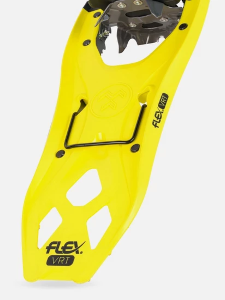
The other purpose is traction. Mountaineering snowshoes have aggressive traction on the bottom of the shoes. This typically is a very large crampon under the ball of the foot. You also will typically have some other traction on the flotation sections of the shoe. This may be a line of teeth that run up and down the shoe or bars that go across the shoe. The more traction you have, the easier it will be to hike on icy or highly packed trails when they start to become steeply inclined.
For me, what quickly tells you that a shoe is a mountaineering shoe is the presence of a heel lift, sometimes called televators. These devices are generally a small bar that you lift up and it holds your heel a few inches above the shoe. This is only important when you are climbing hills. What it does is keeps your foot in a more neutral position, and it allows you to relax your calf and Achilles tendon as you climb up hill. It also lets you keep the shoe more aligned with the snow and allows you to get some better traction on the inclines. If you're expecting to do a lot of uphill that's more than 15-20% slope, this little device will allow you to hike longer with less strain on the lower leg.
Brands:
There are 2 major brands of mountaineering snowshoes in the US. MSR and Tubbs. Yes, there are many others out there, but by far you will find these 2 brands the most on the trails. They both are quality, and they offer a variety of shoes. I'm going to focus in on the shoes for mountaineering.
MSR:
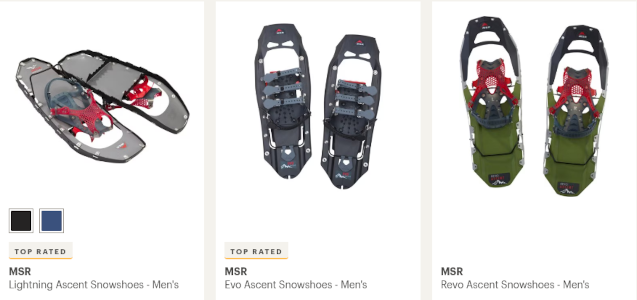
The "ascent" line of snowshoes are best for mountaineering. These are the Lightening Ascent, Revo Ascent, and Evo Ascent. All three of the lines have aggressive traction on the bottom and also have a heel lift. The Lightening and Revo lines have the same binding, a basket type while the Evo is 3 straps across the foot. All use a pin/hole strap and have clips or loops to secure the end of the straps. The Revo and Evo are a plastic deck while the Lightening is a fabric deck. Pricing, as of December 2025, you are talking about $390 for Lightening Ascents, $320 for Revo Ascents, and $260 for Evo Ascents. Sometimes you can find them on sale for up to $100 off.
Tubbs:
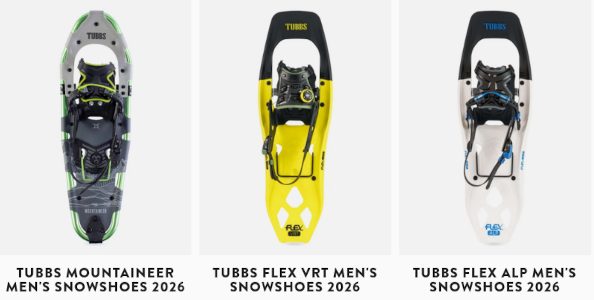
As with MSR, there are three different models to look at. The Mountaineer, Flex VRT, and Flex ALP. All three of the lines have aggressive traction on the bottom and also have a heel lift. They also all have a basket style binding. The Mountaineer is a fabric deck while the others are plastic. The Mountaineer is also a tubular frame and has a bit less traction compared to the other two. The pair of Flex shoes are nearly identical, the big difference being the binding. The Flex VRT has a dial to wind up a cord while the Flex ALP and Mountaineer both have pin/hole straps. All of them have clips to hold the tails. Pricing, as of December 2025, you are talking about $280 for the Mountaineer and Flex VRT models, and $260 for the Flex ALP. Again, you can sometimes find them on sale for up to $100 off.
Which one should you buy? I won't recommend one over another. All 6 models I mentioned above work well. There are other brands I have seen that work well. If you can, try to rent a couple different models and give them a try. If you can't rent the exact model you're considering, try to rent something with a similar binding. There's nothing like trying it out.
I will fully admit I'm in the MSR Lightening Ascent camp and own 2 pairs of different sizes. I love them and they're well worth the cost to me. I know plenty of people that are devoted to each of the other 5 models. I would say the MSR Lighening Ascent, MSR Evo Ascent, Tubbs Flex VRT and Tubbs Flex ALP are probably the most common ones you'll find in use, essentially the most and least expensive of each company. They all work.
There is nothing wrong with going with your wallet and getting what you can afford. If it's not one of these 2 brands, look for the features these brands have. If you can, touch it and compare it to these brands and see if it looks like it will hold up. Many of the other brands do just well on the trail, you don't need to spend a fortune. Who knows, maybe you'll be on the leading edge of a new brand taking over the sport.